The Quiet Beauty of Gongbi: Painting Through Line, Layer and Patience
Two pigeons on a plum branch, and the slow work hidden inside every feather.
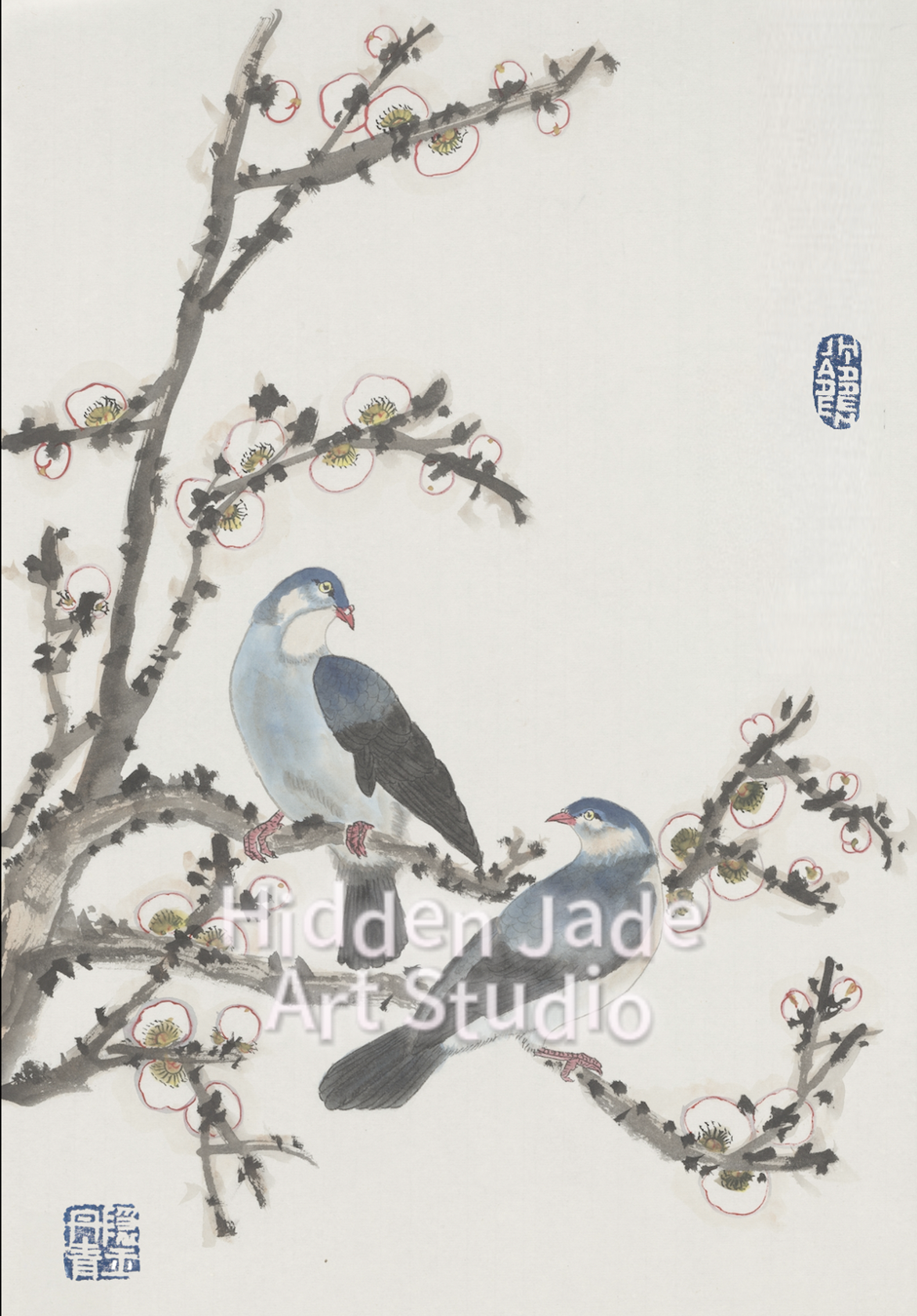
Two pigeons on a plum branch, painted in ink and colour on rice paper.
Look closely at the lower pigeon's wing
Each small feather along its shoulder is drawn as a separate scale, then outlined, shaded and softened into the next. Further down, the long flight feathers darken almost to black before turning a cool slate blue. From across the room, it is simply a pigeon resting on a branch. Up close, it is hundreds of small decisions.
That is the quiet beauty of gongbi (工笔). It rarely demands attention. It rewards the person who comes closer.
In an earlier Brush Story, we placed gongbi and xieyi side by side. This time I want to stay with gongbi alone, and follow one of my father's paintings from its first line to its last touch of colour.
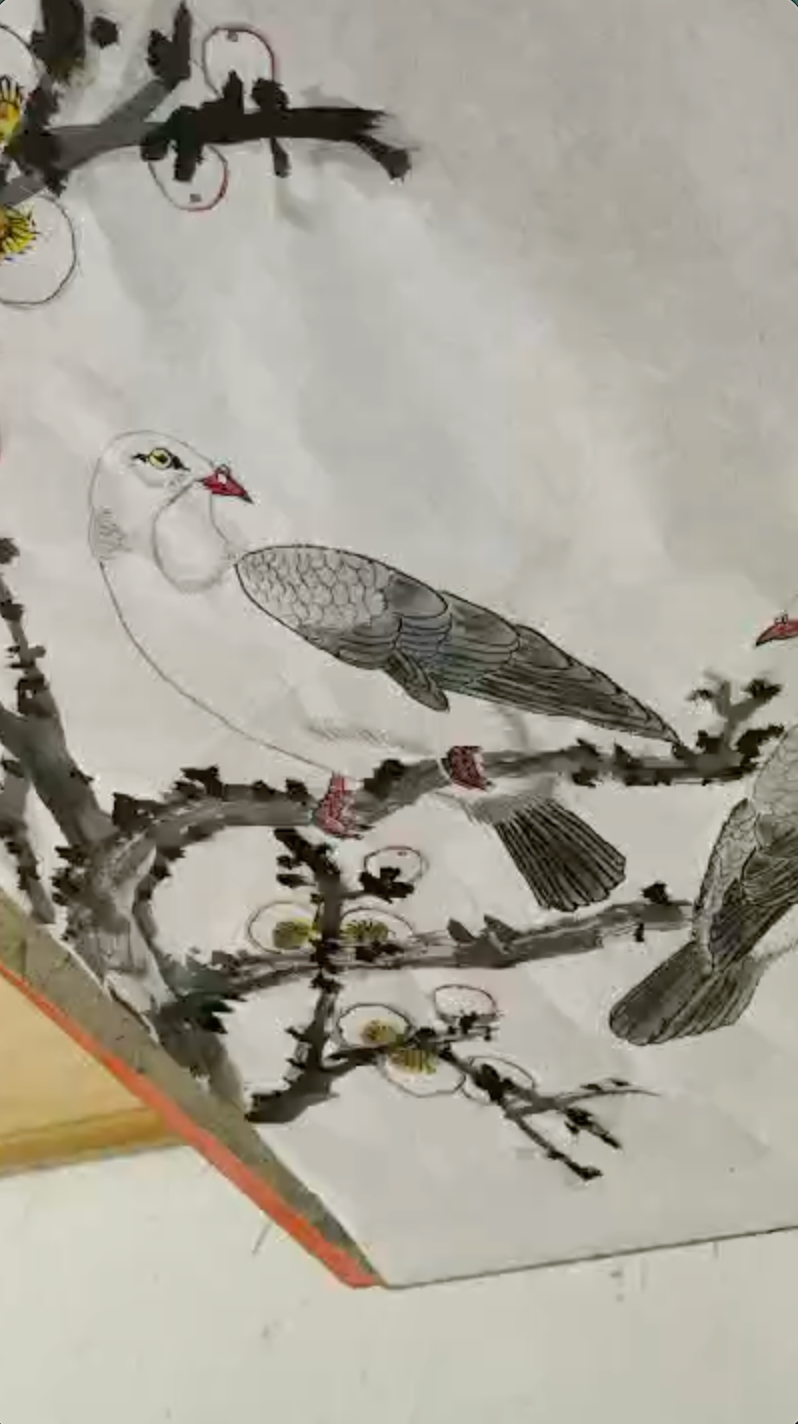
It begins as a line
Before any colour touches the paper, the whole pigeon already exists as a drawing.
In the process footage you can see it: the curve of the head, the rim of the eye, the beak, the long sweep of the back into the tail, all drawn in one fine, even line. For a while the pigeon is almost transparent, a pale shape floating beside a branch that is already finished.
This line is not a sketch that gets covered later. It is the skeleton of the painting. Everything that follows has to sit inside it and keep it visible. If the line wavers, no amount of colour can hide it.
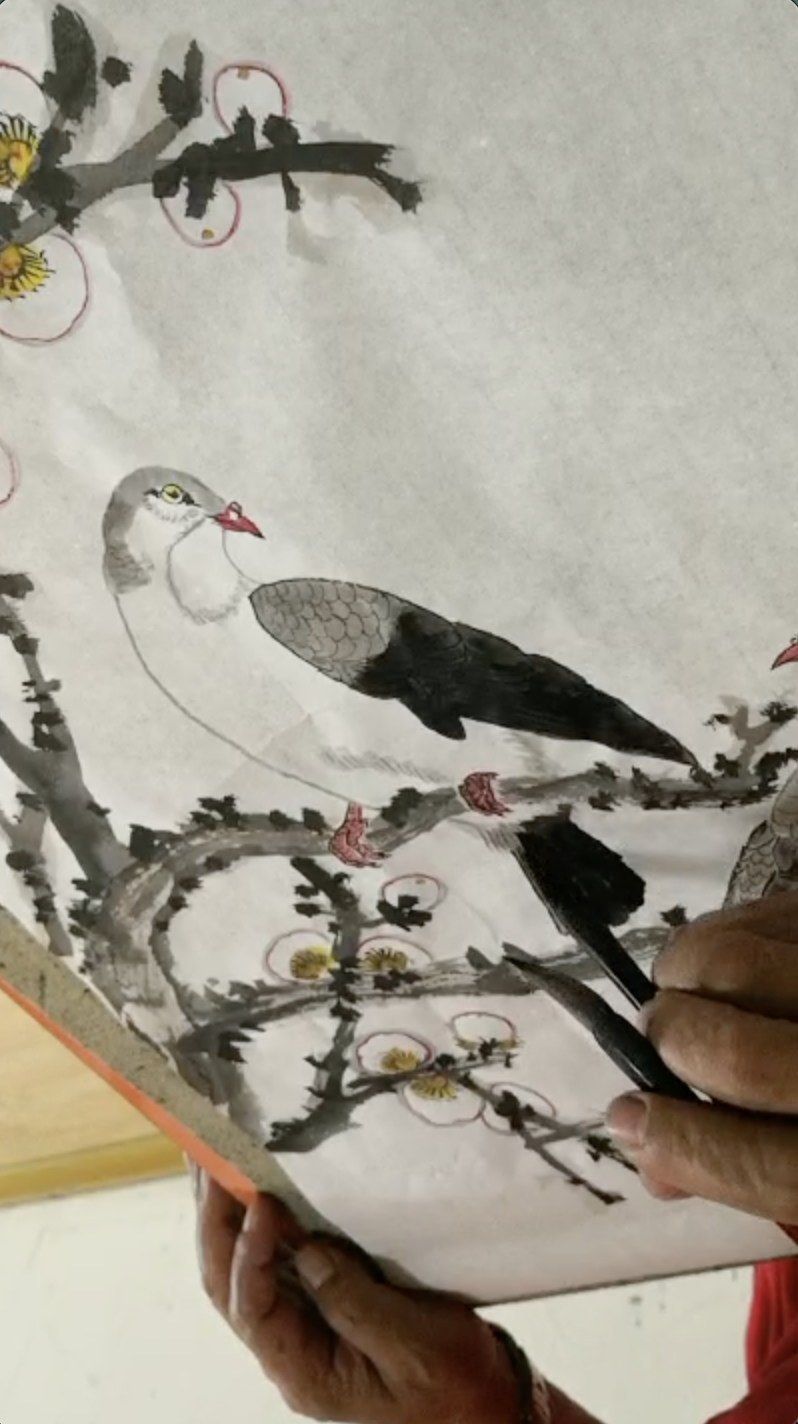
Grey comes before blue
The feathers are not painted blue straight away.
First, my father builds the wing in ink. The shoulder feathers are shaded scale by scale in soft grey; the flight feathers go down darker. At this stage the pigeon is almost monochrome, a study in shades of black.
Only then does colour arrive. In a later frame, blue has been brushed over the grey, and the ink underneath gives it weight. The colour does not have to create the form. The form is already there. The blue simply settles into it.
This is why gongbi colour can look deep without looking heavy. It is not laid on in one thick coat. It is built gradually, stroke over stroke, with the ink structure still showing through.
Small strokes, repeated
Much of a gongbi painting is made of marks too small to notice on their own.
Watch the brush and it barely leaves the pigeon. It touches a feather, lifts, and touches the next. A little more grey along one edge. A little more blue across the wing. No single stroke changes much. Together, they change everything.
The control lies in how little each stroke does. Put down too much at once and the soft passage from dark to light would be lost. So the colour is added in small amounts, looked at, adjusted, and added again, until the painter decides a feather needs a little more blue, or nothing at all.
Knowing when to stop is as much a skill as knowing where to begin.
Where he chose to be free
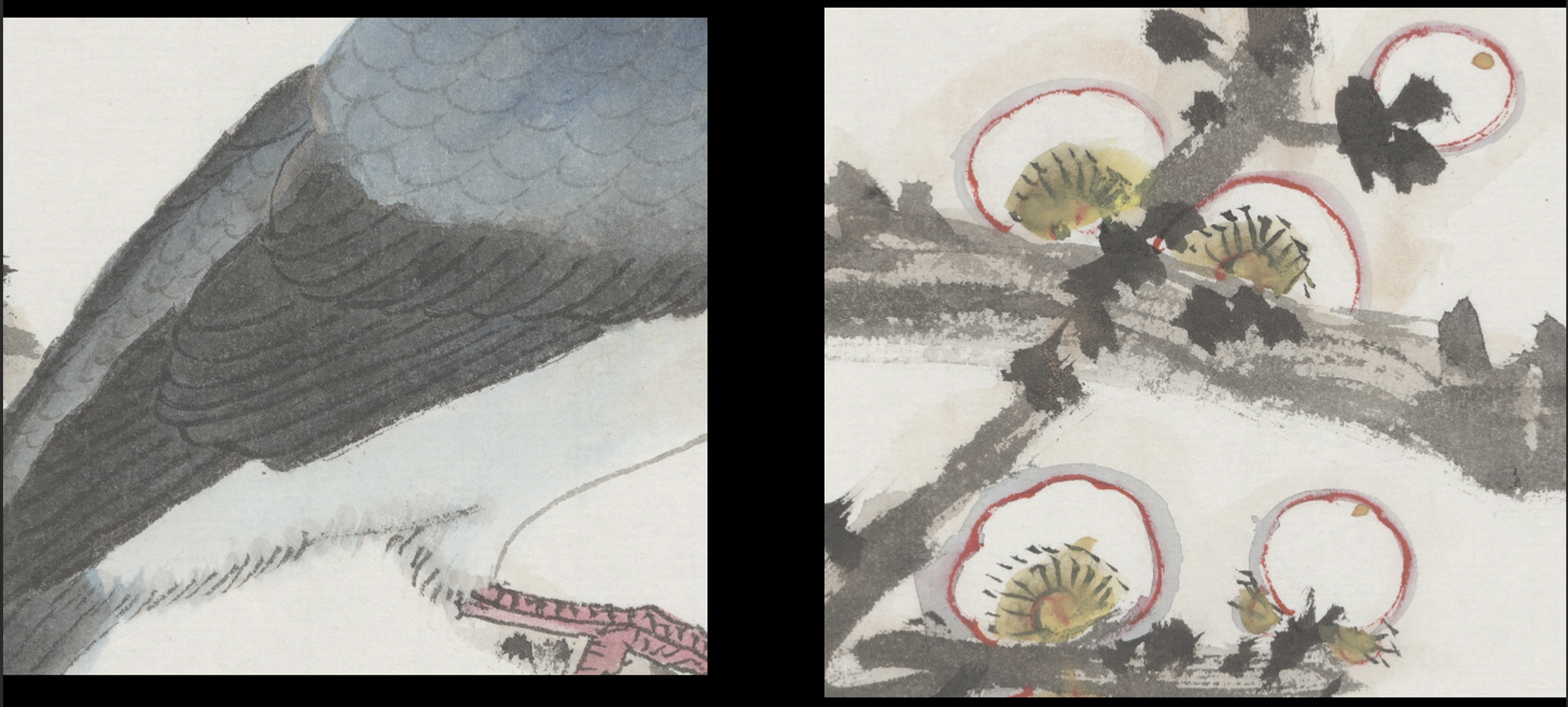
Fine feather detail beside the freer brushwork of the plum branch
Now look at the branches.
They are nothing like the pigeons. The plum wood is brushed in quick, broken strokes of grey ink, dotted with dark moss and buds. Each blossom is just a thin red circle with a touch of yellow at its heart.
Placing meticulous birds on a freely brushed branch is a long-standing approach in flower-and-bird painting, sometimes called 兼工带写: combining careful work with free brushwork. The contrast is deliberate. The loose branch makes the pigeons feel still and present. The careful pigeons give the branch something to hold.
Gongbi, in other words, is not only a technique. It is a decision about where attention goes.
Plum blossom opens in the cold of late winter, often before a single leaf appears, which is why it has long stood for endurance. It is a fitting companion for a way of painting that asks for so much patience.
The same patience, another subject
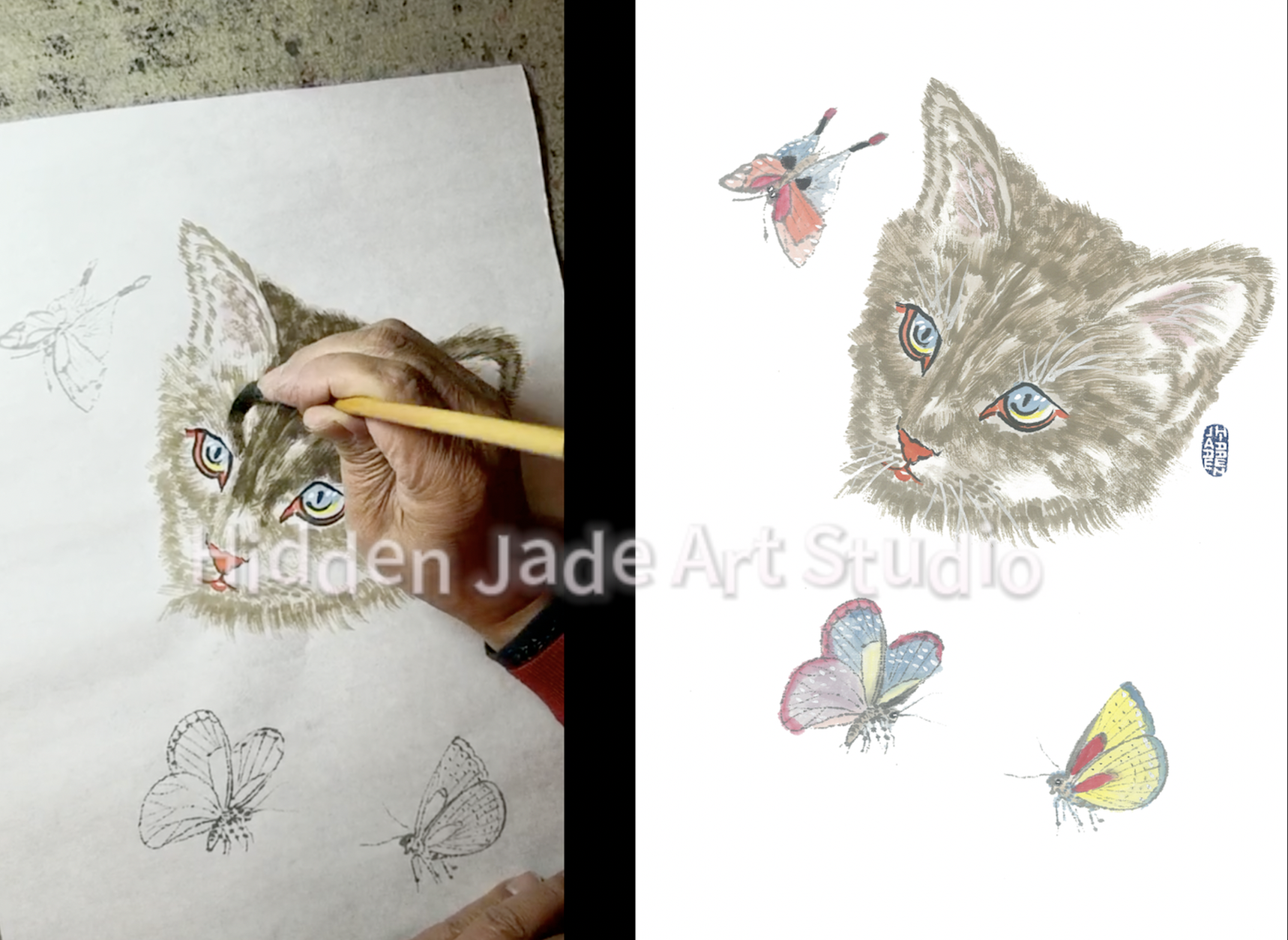
Short brushstrokes build the kitten’s fur. in the finished painting, its whiskers and the butterflies come into view
The same slow method works for fur.
In this painting of a kitten and three butterflies, the fur is not one wash of brown. It is built from short strokes, each one following the way the hair grows. While the cat is being painted, the butterflies wait in the corners of the paper as fine outlines, not yet coloured. Near the very end, pale whiskers are drawn over the fur, and the face suddenly comes alive.
What patience leaves behind
No single stroke in a gongbi painting is dramatic. There is no moment when the picture suddenly appears. It comes the way spring comes to a plum branch: slowly, and then one day you notice it.
What remains in the finished work is not only the image of two pigeons. It is the time it took. The line drawn first and never lost. The grey beneath the blue. The small strokes, repeated until the feathers were there.
Look closely, and all of it is still there on the paper.
